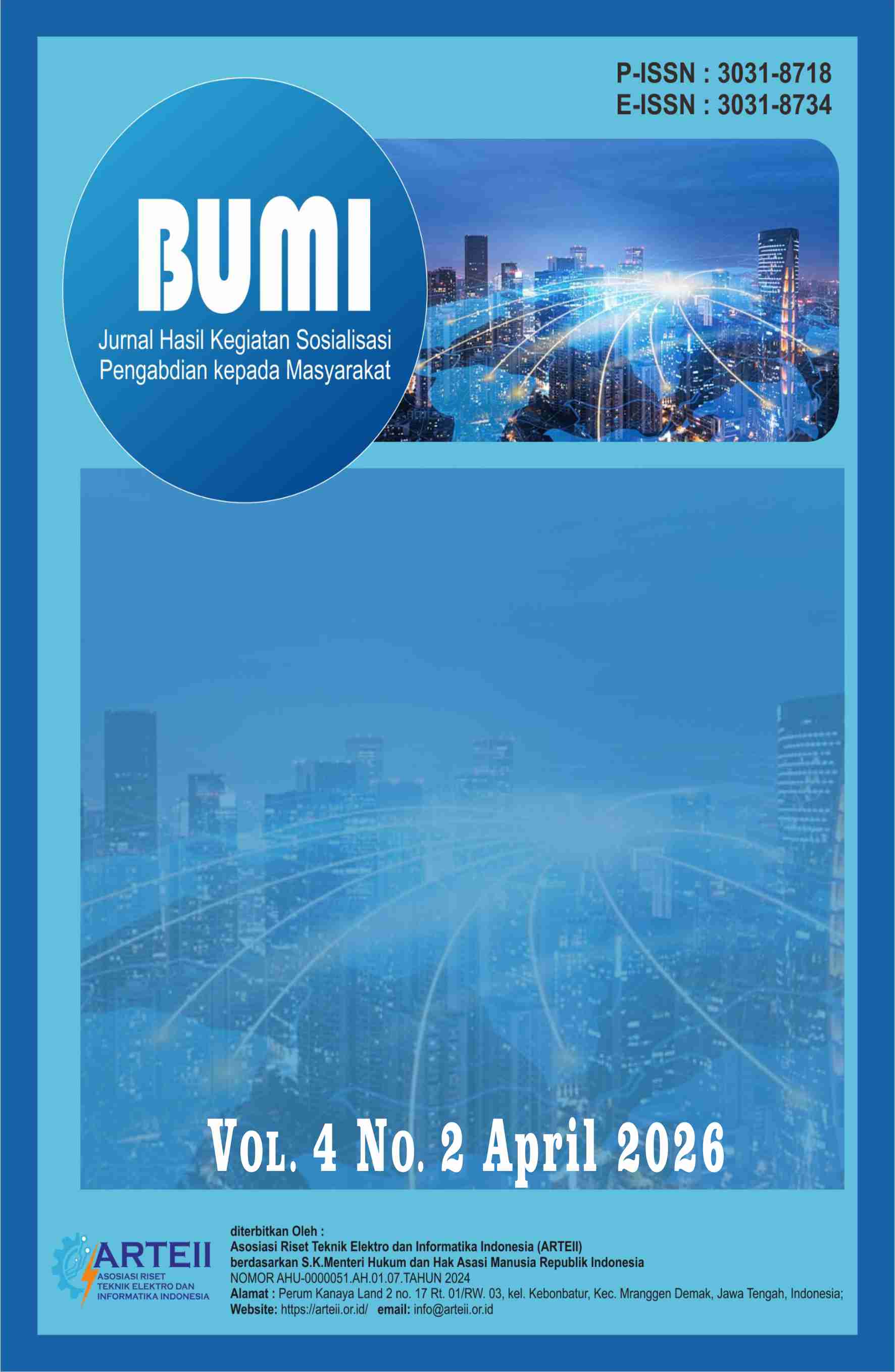
Pelatihan Pengembangan Aplikasi Mobile Menggunakan Flutter Konsep Dasar Layout untuk Guru dan Dosen pada PPMULTINDO
DOI:
https://doi.org/10.61132/bumi.v4i2.1600Keywords:
Android, Digital learning, Educational innovation, Flutter, Mobile applications, PPMultindoAbstract
The rapid development of information technology has had a significant impact on the world of education, particularly in the use of mobile applications as learning media. Developing Android-based applications using Flutter is one innovation that can increase efficiency and provide a more personalized and adaptive learning experience. In this context, educators are required to continue innovating to meet the increasingly diverse and dynamic needs of students in the digital era. The Multimedia and Information Technology Professional Association (PPMultindo), an organization that brings together technology professionals, is taking advantage of this opportunity by developing an Android-based learning platform. This platform is designed to provide easier, more flexible, and more interactive access to learning materials, as well as support the process of designing more engaging materials. Features such as learning data analysis, material recommendations, and automatic evaluation are expected to increase the effectiveness and efficiency of the teaching and learning process, while also providing a means for collaboration between members. However, the implementation of this technology still faces various challenges, such as limited technological competence of educators, inadequate infrastructure, and the need for curriculum adjustments. Therefore, collaborative efforts are needed to optimize the use of mobile technology to support educational transformation.
References
Akpen, C. N., Asaolu, S., Atobatele, S., Okagbue, H., & Sampson, S. (2024). Impact of online learning on student’s performance and engagement: a systematic review. Discover Education, 3(1), 205. https://doi.org/10.1007/s44217-024-00253-0
Baillifard, A., Gabella, M., Lavenex, P. B., & Martarelli, C. S. (2023). Implementing Learning Principles with a Personal AI Tutor: A Case Study. http://arxiv.org/abs/2309.13060
Cenita, J. A., & De Guzman, Z. (2023). Education in the Digital World: From the Lens of Millennial Learners. International Journal of Computing Sciences Research, 7, 1816–1829. https://doi.org/10.25147/ijcsr.2017.001.1.132
Erandika, L., Wijayanayake, J. I., & Prasadika, J. (2023). ANALYZING THE IMPACT OF STUDENT ENGAGEMENT ON LEARNING OUTCOMES IN E-LEARNING PLATFORMS: A SYSTEMATIC REVIEW OF LITRETURE. https://www.researchgate.net/publication/376456861
Gandasari, F., Koeswinda, A. S., Putri, A. K., Kumala, D. A. P., & Muftihah, N. (2024). Etika Pemanfaatan Teknologi Artificial Intelligence dalam Penyusunan Tugas Mahasiswa. EDUKATIF : JURNAL ILMU PENDIDIKAN, 6(5), 5572–5578. https://doi.org/10.31004/edukatif.v6i5.7036
Hizam, S. M., Akter, H., Sentosa, I., & Ahmed, W. (2021). Digital competency of educators in the virtual learning environment: a structural equation modeling analysis. IOP Conference Series: Earth and Environmental Science, 704(1), 012023. https://doi.org/10.1088/1755-1315/704/1/012023
Khalifa, M., & Lam, R. (2002). Web-based learning: effects on learning process and outcome. IEEE Transactions on Education, 45(4), 350–356. https://doi.org/10.1109/TE.2002.804395
Möller, M., Nirmal, G., Fabietti, D., Stierstorfer, Q., Zakhvatkin, M., Sommerfeld, H., & Schütt, S. (2024). Revolutionising Distance Learning: A Comparative Study of Learning Progress with AI-Driven Tutoring.
Nafisah, N. T., Maria, F., Amanatullah, M. R., & Sutabri, T. (2024). Penggunaan Teknologi Artificial Intelligence Untuk Peningkatan Pembelajaran Pada SMA Nurul Iman Palembang Menggunakan ITIL V3 (Vol. 18, Issue 1). https://journal.fkom.uniku.ac.id/ilkom
Nurcahyani Yahya, S., Aurelia, A., Rahmatillah, F., Waruwu, S. Y., & Amelia, N. (2024). Pemanfaatan AI sebagai Media Pembelajaran dalam Pendidikan Ekonomi. Jurnal Disrupsi Bisnis, 7(6), 823–830. https://doi.org/10.32493/drb.v7i6.46279
Owoc, M. L., Sawicka, A., & Weichbroth, P. (2021). Artificial Intelligence Technologies in Education: Benefits, Challenges and Strategies of Implementation (pp. 37–58). https://doi.org/10.1007/978-3-030-85001-2_4
Prabowo, H., Harjono Muljo, H., & Wawan Cenggoro, T. (2020). PENGEMBANGAN PORTAL PEMBELAJARAN ONLINE BERBASIS ARTIFICIAL INTELLIGENCE DALAM KERANGKA TEAM-BASED LEARNING. https://www.researchgate.net/publication/358273402
Tong, R., Li, H., Liang, J., & Wen, Q. (2024). Developing and Deploying Industry Standards for Artificial Intelligence in Education (AIED): Challenges, Strategies, and Future Directions.
Triyanto, T. (2020). Peluang dan tantangan pendidikan karakter di era digital. Jurnal Civics: Media Kajian Kewarganegaraan, 17(2), 175–184. https://doi.org/10.21831/jc.v17i2.35476
Downloads
Published
How to Cite
Issue
Section
License
Copyright (c) 2026 Bumi: Jurnal Hasil Kegiatan Sosialisasi Pengabdian kepada Masyarakat

This work is licensed under a Creative Commons Attribution-ShareAlike 4.0 International License.